


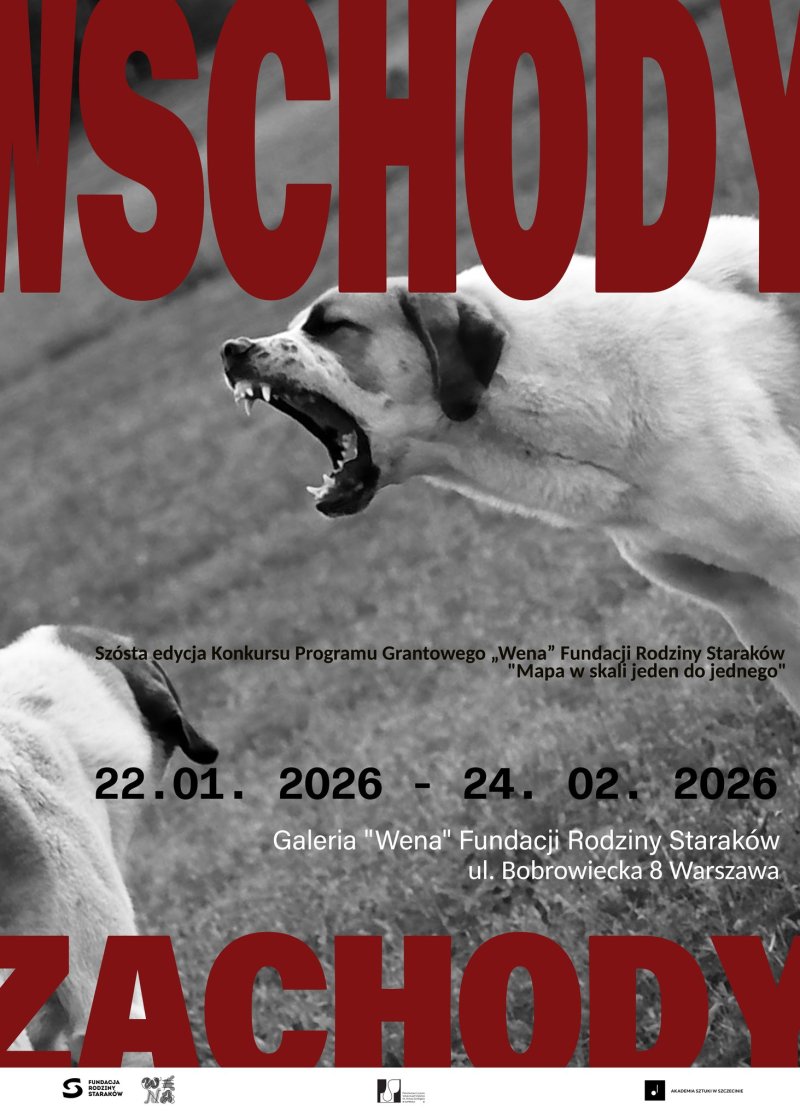
East - West/Sunrise - Sunset
We invite you to the unique exhibition “Wschody Zachody,” which has been on display at the Starak Family Foundation’s WENA Gallery since January 22, 2026.
The exhibition is the result of a collaboration between the Artur Grottger State High School of Fine Arts in Supraśl and the Academy of Art in Szczecin as part of the 6th edition of the WENA Grant Program Competition, dedicated to the theme “A Map on a Scale of One to One.” This is the first project in the history of the Program based on artistic collaboration between high school students and art college students.
This multimedia, socially engaged narrative attempts to foster a multidimensional dialogue between two border regions of Poland—areas marked by a difficult and complex history, as well as political and ideological divisions, existing in a state of perpetual limbo.

The border is a place where nothing is final, but anything can happen - write the exhibition’s curators, students Weronika Ziółkowska and Zofia Białkowska.
It is a space of great hopes and expectations, yet also of disappointments, suffering, and trauma, particularly affected in recent years by a profound humanitarian crisis.
The exhibition becomes a space of shared feeling and empathy toward those whose fate is often silenced. It is also an artistic attempt—undertaken by young people, future artists—to capture experiences that cannot be expressed in words.

The project was created by Marta Mariańska, a teacher of intermedia at the PLSP in Supraśl, and developed in collaboration with Dr. Agata Michowska-Łazarczyk, a professor at the Academy of Art in Szczecin in the Department of Media Arts, Photography, and Experimental Film. The project team consisted of third-year students at the PLSP in Supraśl: Wiktoria Lewczuk, Natalia Sorko, Gabriela Szatkowska, Eliza Wawrusiewicz, and Julia Żementowska.

As part of the “Wschody Zachody” project, the program included a performance by student Kacper Janowski and the film “Nie przekraczając granic” / “Without Crossing Borders” by Zofia Białkowska and Weronika Ziółkowska, students at the Academy of Art in Szczecin, which was presented in Berlin in September 2025 by Spore Initiative.


The exhibition is curated by Marta Mariańska, Dr. Agata Michowska-Łazarczyk, Zofia Białkowska, and Weronika Ziółkowska.


The exhibition runs from January 22 to February 24, 2026. Admission is free.
WENA Gallery, 8 Bobrowiecka Street, Warsaw
Curatorial Texts
A golden frame, dormant rivers, the corridors of Europe.
The exhibition East West takes place in a corridor—a space of passage, suspension, and waiting. This is no coincidence. A border, like a corridor, is the architecture of temporariness: a place where nothing is final, but anything can happen. In this liminal tunnel, two realities meet—the official one, based on the language of the state, law, and security, and the unofficial, organic one, composed of bodies, emotions, fear, and exhaustion. In this collision, a unique, contemporary Way of the Cross emerges.
Each station of the exhibition is an attempt to translate the experience of the border into symbolic language. Not to appropriate the suffering of others, but to extract from it the structures—social, religious, legal—that make this suffering possible and repeatable. In the 21st century, the border is no longer a line on a map, but an ethical mechanism. A place where law becomes theology, and security—faith.
The title of the exhibition, Easts Wests, is a play on light and direction. It refers to movement—to those trying to enter and those trying to keep them out. In the Polish imagination, “the East” is a place of danger, while “the West” is a promise of normality. But on the border, these categories cease to apply: here, everything is simultaneously East and West. The East begins in Hajnówka, the West ends in Berlin, and between them stretches a strip of land governed by a separate law—unwritten, military, devoid of witnesses.
Since September 2021, Poland’s eastern border has become a laboratory for a new European order. First, a state of emergency was declared, then a closed zone, and finally “border protection regulations,” which, despite the formal end of the state of emergency, have entrenched its logic. In 2024, a system of cameras, sensors, and drones covered the entire border from Podlasie to the Lublin region. In 2025—in the name of “national security”—an amendment to the Aliens Act was passed, allowing for the return of individuals crossing the border without the right to apply for asylum, even if they declare their intention to seek international protection. Poland is not alone in this—it is part of a EU-wide deterrence strategy that transforms the border into a screening mechanism.
The border is thus no longer a “place,” but a state of mind and body. It is a language that begins with the word “safety” and ends in silence.
The Stations of the Cross, like other Christian motifs, hold the status of a national ritual in Polish culture. The exhibition deliberately draws on this structure to highlight the tension between the religious conception of suffering and the real suffering of today’s marginalized. Here, the stations are not illustrations but a counterpoint.
In the Catholic imagination, Poland is a “suffering” and “sacrificial” nation, but at the border, this myth turns against others. In the name of the cross, indifference is justified here; in the name of mercy—violence. Each station is an attempt to dismantle this mechanism, to reveal how spirituality has been co-opted by the state apparatus. Golden frames, icons, liturgical rhythms—there is no longer any sanctity in these elements; instead, there is control, hierarchy, and fear. The Polish border has become a sacred object: it must not be touched, crossed, or questioned.
The exhibition deliberately plays with the risk of aestheticization—because every depiction of suffering is, at the same time, a transformation of it. In art, as in the media, the image of pain can become mere decoration. Hence the question that runs through all the stations: is it possible to show suffering without consuming it?
A golden frame, a level horizon, dormant rivers—this is the language Europe uses to speak of others’ suffering. Here, matter takes on the role of witness.
Every year, people whom no one knows die at the eastern border. Every year, the media falls silent sooner, and the reports grow shorter. Their names are not recorded in official state statistics. Instead, the names of activists providing aid are noted in the prosecutor’s files.
This is not an exception. It is a procedure.
East West is an attempt to look into this abyss, an important attempt because it is carried out by young people who are just learning to be part of this world—not to fill it in, but to understand that the very act of looking is already a political act.
Weronika Ziółkowska and Zofia Białkowska
Untitled
Sunrises and sunsets have set the rhythm of life on Earth for millions of years, a rhythm to which all of nature is subject. They also create geographical, political, ideological, religious, economic, and social divisions that lead to the radicalization of views and are a source of ever-increasing chaos in the world. Between the mythical East and West, borders have always existed—both imagined and physical—often taking the form of walls or barbed-wire fences, intended to stem the tide of migrants seeking a safe place to live—far from wars, persecution, or famine. The world turns out to be too small and too helpless to resolve a problem affecting nearly every continent.
The project, which took place last October in eastern Poland, was initiated by Marta Mariańska, who heads the Film and Photography Studio at the Art High School in Supraśl. For her students and the university students from the Video and Transmedia Narratives Studio at the Academy of Fine Arts in Szczecin who were invited to collaborate, it was a time of extremely intense and important meetings and conversations, but also of strong emotions associated with learning about the history of the border with Belarus, along which trauma and suffering are concentrated on both sides. Nature remains the silent witness to all these individual stories, revealing its beauty and strength, but also its dark sides. The exhibition East West is an attempt to capture in an artistic form all that which is impossible to convey through words and stories. It is like a lens through which all the places on earth affected by a profound humanitarian crisis—often invisible and pushed to the margins of the flood of information that overwhelms us every day—are brought into focus.
The exhibition is also an attempt to foster a multidimensional dialogue between two border regions of Poland, both of which are marked by a difficult and complex history—a source of inspiration for many poignant works created by young people, the future practitioners of art, in response to a situation that is difficult to resolve. We view it as a space expressing sensitivity, empathy, and compassion—qualities that are so important in today’s complex times, which are challenging for all generations.
Agata Michowska
The East-West Project is a unique opportunity for young people from an art high school to meet with art students, with the aim of observing a foreign, radical, and unusual situation and reflecting on what, in our view, is happening in eastern Poland. We met at the border between countries, emotions, and perceptions to bring our sensibilities into contact.
East West—as the geographically distinct locations of our sites.
East West—as the beginning and the end.
Marta Mariańska


